How to Choose Flexible LED Neon Strip for Custom Signs
TOPBEDA Lighting · Updated October 21, 2026
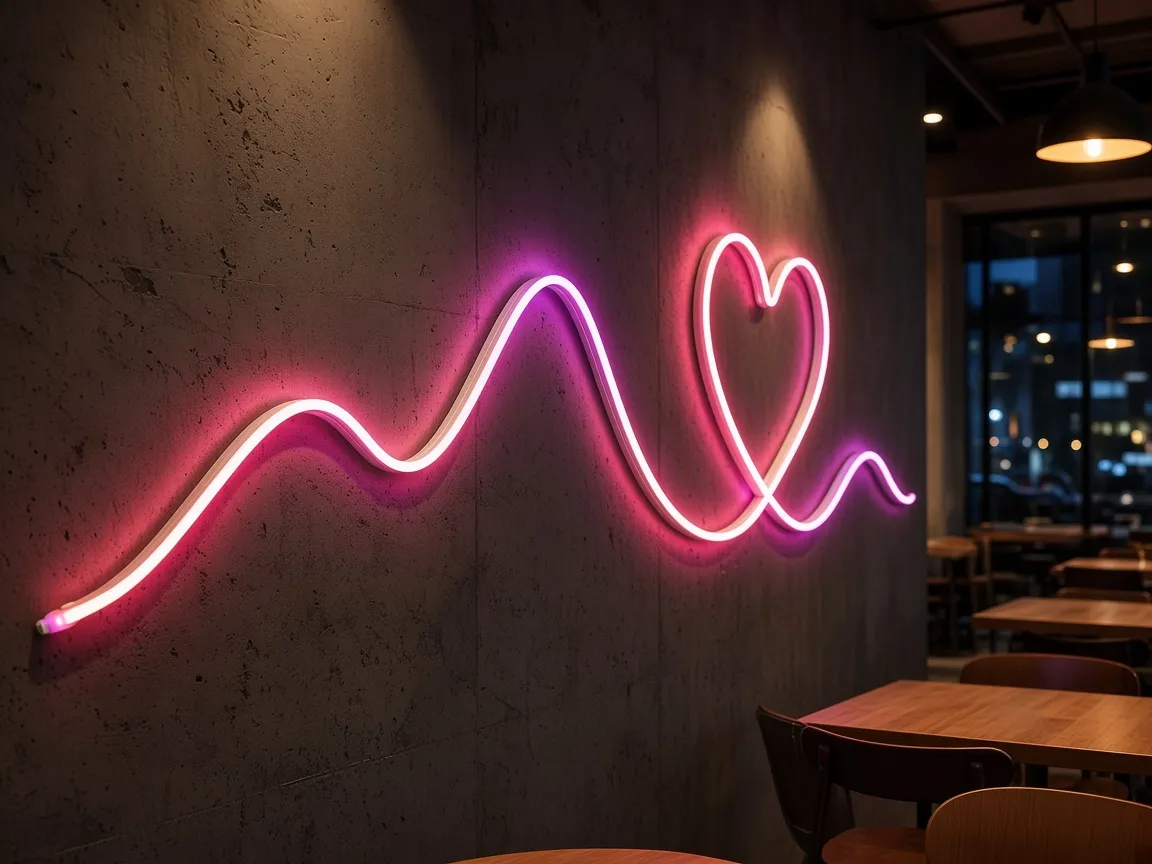 Visualization
Flexible LED neon looks like traditional glass neon but is safer, lighter and far easier to shape. Its biggest selling point is simple: it bends into almost any shape, from script lettering and logos to waves, hearts and architectural outlines. For sign makers, retailers and brands, choosing the right neon strip makes the difference between a sign that looks smooth and professional and one with hot spots, kinks and failed joints. This guide covers the decisions that matter.
Model-specific numbers, including minimum bend radius, cutting unit and maximum run length, vary between products. Where you need those figures, ask us for the spec sheet for the exact model.
1. Bend direction: side-bend, top-bend or 3D
Neon strips are built to bend in one main direction, and this is the first choice to make.
| Type | How it bends | Light direction | Best for |
|---|---|---|---|
| Side-bend (horizontal) | Bends left and right in the plane of a wall | Emits from the top face, toward the viewer | Letters, logos and shapes on a flat backboard |
| Top-bend (vertical) | Bends up and down | Emits from the top face | Outlining curved edges, arches, building contours |
| 3D / round (360°) | Bends in several directions | Emits all around | Free-form sculptures, hanging décor |
For classic custom signs, side-bend is usually right: the strip lies flat in a channel or clip on an acrylic backboard and its lit face points at the viewer while it curves into letters. Choosing top-bend for lettering is a common mistake, because the strip then has to twist and the glow becomes uneven.
2. Profile size and bend radius
Neon comes in different cross-section sizes. As a general rule:
- Smaller profiles bend tighter, so they suit small script letters and fine details, but give a thinner line of light.
- Larger profiles look bolder from a distance and suit big signs and architecture, but need wider curves.
Before designing, check the minimum bend radius of the model. Bending tighter than specified can crack the internal circuit board or create dark spots. When converting a logo, smooth sharp corners into curves the strip can follow, or plan a cut and joint at sharp angles.
3. Cutting and joints
Neon strips can only be cut at marked cut points. The cutting unit depends on the voltage and LED layout; lower voltage generally allows shorter cutting units. Plan the design so each segment ends at a cut point, otherwise you will have unlit gaps or need to overlap segments.
Every cut end needs an end cap and a sealed connection. For indoor signs, factory connectors and end caps are usually enough. For outdoor use, sealing method matters more and should follow the manufacturer's tested process. If you are producing signs in volume, ordering pre-cut lengths with factory-sealed ends saves labor and reduces failures; ask us about custom lengths.
4. Material: silicone vs PVC
| Silicone neon | PVC neon | |
|---|---|---|
| Feel | Soft, very flexible | Stiffer |
| Light appearance | Smooth, dot-free glow is common | Varies by model |
| UV and heat aging | Generally better resistance to yellowing | More prone to yellowing over time |
| Cost | Higher | Lower |
| Typical use | Premium signs, outdoor, décor | Budget indoor projects |
Our flexible silicone neon strips are designed for a smooth, dot-free glow and easy bending into signs and shapes.
5. Power: USB 5V vs 12V vs 24V
Voltage decides where the neon can be used and how long a run can be.
| USB 5V | 12V | 24V | |
|---|---|---|---|
| Power source | USB adapter, power bank, USB port | Plug-in adapter or driver | Plug-in adapter or driver |
| Practical run length | Short | Medium | Longest |
| Cutting unit | Usually short | Medium | Usually longer |
| Best for | Small signs, desk and wall décor, retail displays, gifts | Medium signs, shop fronts | Large signs, architectural outlines, long runs |
USB 5V is ideal for plug-and-play products sold to end users: small wall signs, gaming room décor and retail displays. It is easy to power and to ship worldwide, because a USB adapter with the right plug and certification can be supplied for each market. 12V and 24V make sense when the total length is longer, when the sign is outdoors, or when it is wired into a building's power. Ask us for the maximum run length of each voltage option.
6. Color and control
- Single color (white, warm white, red, pink, blue, etc.) is the standard for script signs and logos.
- RGB lets one sign change color, controlled by remote or app.
- Addressable / dream-color neon allows chasing and flowing effects for eye-catching retail displays.
Check how the controller is powered and where it sits; for USB products an inline controller on the cable is common.
7. Mounting a custom sign
- Print the design at full size and trace it onto the backboard (usually clear or colored acrylic).
- Mark the start point near where the cable will exit, ideally hidden at the back.
- Fix the neon with mounting clips or channels along the path; add extra clips at curves.
- Drill small holes where the strip must pass behind the board between letters.
- Test before final fixing, then add a hanging kit or standoffs.
Mounting clips and screws are available with our neon strips.
8. Checklist for sign makers and brands
- Bend direction matches the design (side-bend for flat letters)
- Profile size suits the smallest curve in the design
- Cut points align with segment lengths
- Voltage suits size and location (USB 5V for small plug-and-play items)
- Indoor or outdoor rating confirmed for the model
- Power adapter certified for the destination market
- Packaging and branding planned if selling as private label (see OEM options)
9. Common mistakes in neon sign projects
| Mistake | Result | Fix |
|---|---|---|
| Top-bend neon used for flat lettering | Twisting, uneven glow | Use side-bend for letters on a backboard |
| Curves tighter than the minimum radius | Dark spots, cracked circuit | Redraw the design with wider curves or use a smaller profile |
| Cutting between cut points | Unlit section | Design segments to cut-point lengths |
| Long USB 5V runs | Dimming at the far end | Shorten runs or move to 12V/24V |
| Indoor neon used outside | Moisture failure | Choose an outdoor-rated model and sealed ends |
What to send us for a quote
Send your design file or a sketch with overall size, the colors, indoor or outdoor use, the destination country (for plug and certification), quantity, and whether you want finished signs, pre-cut lengths or reels. We will recommend a profile and voltage and send the spec sheet with bend radius and cutting unit for the proposed model.
FAQ
Can LED neon strip bend into letters?
Yes. Side-bend (horizontal bend) neon is the usual choice for letters and logos on a flat backboard. Tight curves depend on the profile size; ask us for the minimum bend radius of each model.
Can I cut LED neon strip?
Most neon strips can only be cut at marked cut points. The cutting unit depends on voltage and LED layout; ask us for the spec sheet before designing.
Is USB 5V neon bright enough for a sign?
For small indoor signs and décor, usually yes. For larger signs, longer runs or outdoor use, 12V or 24V is normally the better choice.
Can neon strips be used outdoors?
Only models rated for outdoor use, with sealed end caps and outdoor-rated power supplies. Check the IP rating of the specific model.
Related products
Planning a project?
Send us your market, quantity and requirements. We reply within 1 business day with model recommendations and the spec sheet.